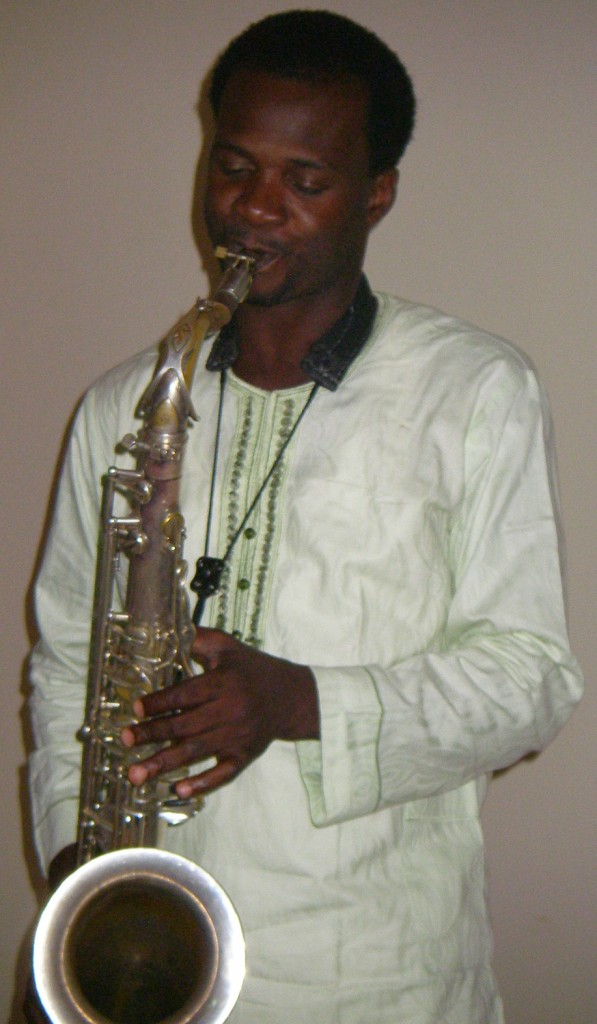
Showing posts with label tenor sax. Show all posts

Thursday, 26 December 2013

Au Revoir, Yusef Lateef

I’m seriously getting tired of this. Seems like every horn man I admire has passed on. Maybe it is a function of the fact that I do not especially like neo-con jazz and do my best to avoid those young conservatory players who approach the music in the same way a classical violinist does, following the rules, loaded with technique but void of creativity and innovation. This week Yusef Lateef left the earth. At least Yusef made it to the advanced age of 93 – unlike most musicians of his generation, he must have had some health care.

Jackie mentioned to me last week that her high school concert band was chock-a-block with saxophonists and as one of the seniors she was asked to diversify and play either oboe or bari. At one time I played oboe in school and told her that my inspiration to do so was Yusef Lateef, maybe the only jazz player in history to do anything worthwhile on that cool-sounding but testy and inflexible double reed. I asked her to seek out some of Yusef’s music on YouTube. A premonition?

Yusef came up in 1940s bebop and blues when cities like Detroit had a thriving scene of their own; he was a tenor player at the core, but by the 1950s he began to introduce other instruments to his repertoire, pioneering what came to be labeled as “world music”. Unlike many pioneers, however, he was not shot dead in his tracks and survived to play music that nobody else had in their head. Like contemporary Rahsaan Roland Kirk, many admired him but nobody copied him. And he stood out from Trane’s mighty shadow.

In reading obits in the Detroit Free Press and New York Times, I find it ironic that Yusef gained academic music degrees only after he had already been one of jazz’ leading hornmen for decades. Who could possibly have been good enough to teach him? And subsequently, what became of his own students? Apparently he turned to academia to eat well, teaching at U. Mass. Amherst in the 1970s, a period when luminaries like Archie Shepp and Max Roach were on the faculty.

Although Yusef’s music took off for outer space, he was rooted in the blues, no better shown than in the 1960 recording 'Teef under Louis Hayes’ name on VeeJay, a straightahead workout which is a favorite of mine. I also particularly like Live at Pep's Vols. 1 and 2 on Impulse from the mid-60s. Yusef continued recording until earlier this year, his last, Light by the Universal Quartet, done in Denmark just this past spring at age 92.

One less legend around to inspire us. Jackie ended up choosing baritone.

Sunday, 9 June 2013

New Africa Shrine, Revisited

Being accused by one of my readers of not keeping my blog up, I feel compelled to post today. Sometimes we take things for granted. I suppose I fall into that boat about the New Africa Shrine, which is no more than 400 meters from my doorstep in the estimation of a colleague from London, who was simply amazed at the music coming out of what is ostensibly my neighborhood bar. I haven’t been going there so often lately as the show has become repetitive for me. However, on Thursday I had a contingent of work visitors from the U.K. and U.S. who wanted to pay homage at the Shrine, despite its rough reputation among the Nigerian professionals in our office. The Shrine’s star shines much more brightly overseas than it does locally.

The three foreign guests were simply stunned by the show that Femi Kuti and Positive Force put on at the Shrine that night. The glow of first experience. The place itself, the front-row table, the band rocking its warm-up set, the full horn section, the percussionists, the dancers both on stage and in cages alongside, the crowd, Femi’s star power, his rap, his circular breathing shtick on alto. All things that have become less impressive to me after dozens of times in the same seat over the past year or so. Time to take a fresh look. I will return tonight.

I saw tenor saxophonist Dotun “Dotsax” Bankole up on stage; he sounded excellent in his one solo feature during the first set. Dotun dropped by my house yesterday for a jam. He doesn't get to showcase his talent on stage as much as he might like and always cuts loose whenever I see him privately. We jammed for about an hour and a half before he had to leave for his far-away home in neighboring Ogun State. Free association, Lester Leaps In, and Milestones were all we had time for. As last time we met, we swapped tenors; we both have silver-plate Mark VIs of about the same vintage and he swears mine sounds better because the silver plate is gone and the bare brass resonates differently. Here is a brief track of Dotun improvising unaccompanied on tenor; he is working on a new album of originals which he expects to be complete in about two months.

Femi and the band will be leaving for a summer tour of the U.S. in a couple of weeks, beginning late June. Tenor fans, look for Dotun on stage if you want to hear one of contemporary Africa's best saxophonists.

Thursday, 9 May 2013

Hidden Gems – Billie Harris and Joe Alexander

I've been listening to jazz and improvised music steadily since the 1970's and am constantly exploring new music with a heavy emphasis on saxophone players, especially tenor sax players. Many, if not most, of the players I like have absolutely no commercial following. Just when I thought I’d heard them all, last week I stumbled upon two hidden gems of saxophone playing – from different times and places, but great nonetheless and definitely worth seeking out and listening to. If players this great can go through life without having a visible impact on the music or attaining any sort of wide recognition, is there any hope for the rest of us minor league players?

The first hidden gem is Billie Harris of Los Angeles. I recently heard his album I Want Some Water for the first time, recorded in 1980 and released much later on Nimbus.

Billie’s album is dominated by legendary L.A. pianist Horace Tapscott, and in some ways it is as much Tapscott’s session as Billie’s even though Billie wrote all the tunes; Tapscott is just such a commanding presence. I'm not a great jazz piano aficionado but I find anything that Horace Tapscott comes close to worth a listen. Billie plays tenor, soprano, and flute. His tenor, from photos of the session, is a Martin Committee, which proves that you don’t need to play a Selmer to get that spiritual ‘Coltrane sound’. Photographer Mark Weber was at the studio that day, apparently Billie’s only time on record, and has memorialized the day on his web site. Billie Harris is still around, at age 76, and lives in Lancaster, California. Time for another studio date, better late than never? 

The second hidden gem is Joe Alexander, who spent his career in Cleveland and left behind only one recording of his own, the quartet session Blue Jubilee on Jazzland from 1960 (he also appears in a larger group setting on Tadd Dameron's Fontainebleau).

Apparently Joe had quite a local following but never broke out to the national scene. There is an entire web page dedicated to his story on the city of Cleveland’s web site. He is a tough hard bopper who doesn't make a single wrong move on his record, and was good enough a player that Cannonball Adderley produced Blue Jubilee with the rhythm section of Bobby Timmons, Sam Jones, and Tootie Heath! I wonder how many other players this great and unheralded graced America’s lounges and bar rooms in my father’s generation? Joe died at the young age of 41 in 1970. I'm sure being a saxophonist during the 1950's and 60's didn't come with health care. Check out his disc which has been re-released on Fresh Sound.

I find it refreshing that the music itself is so deep that after almost 40 years of listening, there is still plenty of great stuff out there waiting to be discovered.

Monday, 22 April 2013

Easter Sunday Blues Jam in Penang


I travelled back to Penang for the Easter break, arriving just in time for an Easter Sunday afternoon jam at the Little Penang Street Market with an assemblage of the Penang Blues Brothers (plus one sister) – Kim Gooi and James Lochhead notorious among the bros. Jackie and I brought our tenors – I played my King Super 20 and Jackie her Kohlert 55.

We stuck to the common language of blues; struggles with Windows Movie Maker aside, here is a video of “Trouble, Trouble” on YouTube, featuring James performing his signature tune on keys and vocals. Interesting to compare this to the same tune done at the same venue about a year ago.


There were some nice photos as well. The players are James Lochhead, keyboard and vocals; Kim Gooi, harp; Russell Steadman, bass and vocals; Tapa, drums; Sid, guitar; Jackie Ashkin, tenor sax; and, Ron Ashkin, tenor sax.

Sunday, 7 April 2013

Interview with Tenor Saxophonist Ellery Eskelin

Ellery Eskelin creates with a vintage Conn
New York tenor saxophonist and composer Ellery Eskelin was gracious enough to consent to an interview on Crazy Bent Brass Tube this week. Ellery is a consistently interesting improviser and he recently celebrated 30 years in New York doing what he loves. He is a prolific and creative recording artist as well as the author of the intelligent blog Musings from a Saxophonist. My questions are in bold (RA) and Ellery's answers follow (EE); I did not edit any of his responses.

Interview with Ellery Eskelin, April 7, 2013

RA: When did you make the conscious decision to follow music as a career regardless of the economic consequences? And creative improvised music to boot? Didn’t your parents want you to be a dentist or an accountant? 

EE: I've wanted to be a jazz musician since I was ten years old. That desire overrode everything else. My parents were very supportive of me being a musician although they did have concerns about the type of music I played. 

RA: How have you managed to stay fresh and creative for 30+ years? Most of the so-called “young lions” have never progressed and are stuck in a rut in middle age – downright boring to listen to. 

EE: The process is exactly the same as it was the first day I got the horn. Still trying to figure out what I can do on it. I'm not too concerned with style or idiom. There's too much music that pulls on me. Plus, the old masters set the bar so high that I'm constantly inspired to push myself every day.

RA: What is your creative “well” – where do you pull inspiration from day after day?

EE: I love what I do. And it’s the way I express myself in the world. Plus, there's so much to do and such a limited time to accomplish it in. 

RA: Do you have a specific approach or “strategy” in mind when you begin a solo? If so, can you give some insight? 

EE: Whenever I'm improvising I think about what the music needs and try and do that. It requires an immediate, in the moment, non verbal state of mind, so that usually necessitates a feeling of movement, a gesture or a sense of phrasing just as I'm about to play. Once I have an idea of a musical shape the notes come to me at the very last moment, as I'm playing. 

RA: How have you avoided recording “Ellery Eskelin with Strings”? (or have you and I am unaware?) 

EE: See "Vanishing Point" (hatOLOGY 577) recorded in 2000 with Mat Maneri: viola, Erik Friedlander: cello, Mark Dresser: bass, Matt Moran: vibraphone. Completely improvised music. I'm rather proud if it. 

RA: Have you ever been forced to play weddings and bar mitzvahs or teach 8-year-olds to stay in music? 

EE: I played weddings when I was coming up. At a certain point, the singers could no longer follow my solos without getting lost so I sold my tuxedo and got a day job (shipping clerk at a record label) until my touring picked up enough that I could let that go as well. 

I've not yet taught a young person but I think I would enjoy the opportunity to approach things a bit differently, more direct ear learning and an introduction to basic I IV V harmony and improvising as soon as they could get around the horn a little. 

RA: Your most ridiculous day gig? 

EE: Well, I was a weekend janitor in a shopping mall for a little while during my school years. I like to think of that as good honest work. Worked on a commercial roofing crew for a summer. All the guys would keep telling me, "stay in school if you don't want to wind up doing this for a living"! 

RA: How do you deal with the egos in the music business without it getting under your skin? Seems like a large proportion of talented musicians are not nice people. 

EE: Actually I don't find that to be the case. The large proportion of the musicians I've met in my life have been pretty down to earth. 

RA: Do you feel you are missing out on anything in life because you pursued creative music as your profession? What about your family – have they missed out on something? 

EE: No, but when I realized that the president was younger than me it did get me thinking. But ironically there is something about going deeply into a subject that teaches us about the world and deepens our appreciation of other people and their work. As for family, I am blessed that they understand and support what I do. I hope that my values and actions can point to some other ways of looking at things in general. 

RA: It appears that you have to be a virtuoso to play any of today’s jazz styles. This kills the music as a people’s music because it limits participation in the creative process. How can the music survive and progress without becoming another form of classical music dependent on the conservatory? 

EE: I don't agree that being a virtuoso limits the audience's participation. If anything a certain kind of demonstrable virtuosity is something that audiences often grab onto even if it's not always deeply artistic. But jazz has never been a popular music with the public at large. In my experience the best thing for any musician to do is commit 100% to their vision and play with the commensurate conviction required to evoke some kind of emotional feeling in the listener. And besides, virtuosity comes in many forms. I consider Ben Webster to be a virtuoso in his sublime delivery of ballads. 

RA: I have a talented 16-year-old who plays tenor. But music is not her only talent/interest. Any suggestions on how she can stay engaged as a performer? Most young people quit playing after school. 

EE: Not sure how to answer that question. But in as much as music is a social event (playing with other people and playing for other people) I would imagine that maintaining that social connection would be beneficial. 

RA: Do you have some recommended learning resources for those not interested in pattern playing or paid-by-the-note tenor styles? 

EE: The idea of "learning resources" in itself seems to imply some kind of organizational methodology that often runs counter to want you're speaking about (which to me has more to do with the nuances of one's delivery). I recommend modeling one's playing after vocalists as a way of avoiding calisthenics and the playing of too many notes. Concentrate on phrasing and the active use of silence. Personally I don't like to think so much in terms of "lines" as much as I want to think in terms of melody. Having a strong sense of what you're doing with (or against) the rhythm also helps. 

RA: Thank you, Ellery.

Here are links to Ellery's web site, blog, and Facebook and YouTube pages:
web site
blog
facebook
youtube

Tuesday, 26 March 2013

Ellery Eskelin - New CD Release Announcement Trio New York II

Just received this in my email from Ellery Eskelin and thought I would take the opportunity to promote a really fine saxophonist.

TRIO NEW YORK II is NOW Available... Listen to samples on the website... See the promotional video on YouTube… Order on-line using Pay Pal for Immediate Delivery Worldwide...

Please visit the website and click the TRIO NEW YORK link for complete information and track samples
Have a look at the TRIO NEW YORK II video on Youtube. 
To ORDER NOW simply visit the Mail Order page. You’ll have the CD in no time!

ELLERY ESKELIN - TRIO NEW YORK II
prime source CD 7010

Ellery Eskelin - tenor saxophone
Gary Versace - Hammond B3 organ
Gerald Cleaver - drums

The New Yorker magazine recently referred to me as a saxophonist “with a romantic streak that runs parallel to his experimental leanings”. I like that. Romance is a descriptor that is rarely associated with the improv scene in New York City. And for the past couple of decades that is what I’ve been doing mostly. I’ve always thought of “Trio New York” as a free improvisation unit, in some ways a continuation of the type of work I’ve been doing all along, in other ways a distinct break from many of the concepts I’d been working with previously. For those of you familiar with our first recording, you'll know that we use the Great American Songbook as our source material.

“Trio New York II” is the second recording by this group and represents an evolution, the band having fine tuned it’s musical processes from gig to gig though our touring in Europe as well as performances in Canada and the US, most recently being the Detroit Jazz Festival. I’m very proud to be working with two of the great musicians of our time, organist Gary Versace (who knows his way around a Hammond organ and knows how to be creative with it) and Gerald Cleaver (who is both swinging and free, always with impressive dynamic sensitivity). This new release also coincides with the fact that as of this month I’ve been living in New York City for thirty years. A lot has happened during that time and I feel as though I’m finally in a place where I can truly integrate all my experiences into the music, from the early days up until today.

As for this recording, please know that it’s very important to me to take the extra time and expense to document this work and present it to you as a physical entity with the highest standards of artistic and technical quality possible. This documentation is not only central to my progress as an artist but I feel it is doubly important that as we are asking for your time and attention you should understand that you are getting a state of the art recording for your collection that you can value for many years to come. Trio New York II is released on my own “prime source” label.

Thank You,
Ellery Eskelin

Sunday, 24 March 2013

Two Original Tracks from Saxophonist Dotun Bankole

Tenor Saxophonist Dotun “Dotsax” Bankole dropped by my house the other night for a jam. He plays a 156k silver plate Mark VI which is about a year younger than the horn I've been playing lately, a 148k Mark VI that is basically bare brass, having been stripped of its silver plate a long time ago. The horns are brothers from the late 60's, although his has a high F# key and mine doesn't  Dotun really liked the resonance of my horn and we traded instruments for the evening. He is playing on a Jody Jazz metal mouthpiece which was given to him by the manufacturer while on tour in the States a couple of months ago with Femi Kuti.

Dotun was bemoaning the scarcity of jazz in present-day Lagos. There is not a single venue in this city of 17 million that features live jazz every day. I thought maybe it was just me because I have played out less this past year than in any year in recent memory, although I have been working in a city which is lauded in some media circles as one of the really happening places in the third world. Not really happening for jazz since there is practically no place to jam, even for excellent local players, and not much happening even for home-grown styles like afrobeat although the music press refers to afrobeat as being really popular worldwide – I've previously written about that paradox.

In any event, Dotun continues to improvise and create on his saxophone. Recently he has been working on two original tracks in the studio: Irawo Owuro and Aja Nti Ele, where he plays soprano sax rather than his more usual tenor. You can listen to these two works-in-progress here and look for and buy the CD when it is released. Click on the track names to download and listen. Meanwhile, you can catch Dotsax playing tenor behind Femi Kuti at the New Africa Shrine in Ikeja, Lagos, on Thursday and Sunday evenings.

Saturday, 15 December 2012

Some Astounding Tenor Playing

I've been listening to the Mosaic 7-CD box set The Complete Blue Note Andrew Hill Sessions 1963-66 on my iTunes and have been astounded by the saxophone playing on these records. Not new to my ears, but hearing this all in one place has made me sit up wide-eyed and take notice. On these records, pianist Andrew Hill’s small groups featured three of the most astonishing tenor saxophonists ever – Joe Henderson, John Gilmore, and Sam Rivers – pretty much defining “Inside-Outside” playing. All the more astounding considering these recordings were made while John Coltrane was still alive, knowing that Coltrane’s sound and approach has so dominated post-60’s tenor saxophony. 

Rudy Van Gelder’s recordings, which set a high quality benchmark, bring the sound to life, sounding as fresh as if recorded this morning although going on fifty years old. It really says something about the level of Andrew Hill’s musicianship that he was able to attract these three as sidemen. It is nearly impossible to sustain this level of creative intensity and although Andrew played some superb music and was much recognized and awarded later in life, his subsequent recordings never again reached this pinnacle. 

Joe Henderson – the small, introverted man with a big sound – is the best known of the three saxophonists and by far the most widely heard. Personally I took his playing for granted when younger since he could be heard on so many mid-60’s Blue Notes, and I didn't really appreciate him until I saw him perform on the Grant Park main stage at the Chicago Jazz festival back in the mid-1990’s. Somehow seeing him live made me understand the connection between the man and the sound and I have listened to every note of his I can find since then. The paradigm of inside-outside playing. 

John Gilmore – Sun Ra’s tenor saxophonist for more than two decades – to the best of my knowledge never recorded a date as a leader (although he co-led 1957’s Blowin’ In From Chicago with Clifford Jordan). All the more surprising considering that he is someone that John Coltrane looked up to for inspiration and innovation during Trane’s spirit-searching days of the early 60’s. He can be found here and there as a sideman outside of his prolific recordings with Sun Ra’s groups – notably on Paul Bley’s Turning Point, McCoy Tyner’s Today and Tomorrow on Impulse and even on one Art Blakey and the Jazz Messengers session. Here is a video of that session on YouTube – Gilmore in a conservative business suit and Lee Morgan sporting a really bad haircut. 

Sam Rivers – one year departed at this point and still under-recognized. Sam’s own mid-60’s Blue Note sessions are a peak of tenor saxophone playing on their own – the final CD in the Andrew Hill box was in the can when originally recorded and first released under Sam Rivers’ name in the 1970’s as part of a “two-fer” LP – Sam was at a peak of recognition at that time. Sam had played with Miles Davis for a short while prior to the Andrew Hill session, in Miles’ band after George Coleman and just before Wayne Shorter. Sam recorded on Miles in Tokyo and the more recently released Kyoto sessions from the same 1964 Japan tour. To me, these sessions sound better than Miles in Berlin from the next year with Shorter on tenor, but apparently Sam was too wild even for Miles! Maybe too advanced at the time. 

Get hold of the Andrew Hill box on Mosaic if you can, or any of the individual Blue Note CDs if you can’t find the box. The saxophone playing on these mid-1960’s sessions has never been surpassed.

Friday, 9 November 2012

Sean Bergin Has Left Us

Sean Bergin in Amsterdam, 2008
Belated sad news that Amsterdam tenor saxophonist Sean Bergin passed away on September 1. Sean was a great player and I got to know him a bit back in 2008. That year I was working in Nigeria and had a regular transit through Amsterdam Schiphol on my journeys back to Malaysia. One trip through, I stopped off for a lesson with composer and former Willem Breuker Kollektief tenor saxophonist Maarten Van Norden, and Maarten told me about this great locally-famous tenor player who had a regular Sunday afternoon gig. He suggested that I stop by to hear him after our lesson. 

I walked from Maarten's place to De Engelbewaarder (translation: The Guardian Angel), a lovely little canal-side bar at Kloveniersburgwal 59. Sean Bergin was playing with a piano-bass-drums trio and he sounded fantastic on his beat-up bare-brass Mark VI tenor. Great beer and great music. Blue Monk sticks in my mind, with a couple of local horn players sitting in. I chatted a bit with Sean; I recall that he was having reed problems and I offered him a reed out of my case, a 2-1/2, which was too soft for him so he declined. Sean played at De Engelbewaarder every Sunday and I stopped by a couple more times through the coming months to hear him. I brought Jackie by to listen during the summer of 2009 when she was in Holland riding with Coby and Marlies Van Baalen, but unfortunately Sean was on hiatus that Sunday and we missed out. 

Sean was one of those unsung local heroes who didn't build much of a following outside of his hometown but sure was a great, no, world class, player. He had recorded with Mal Waldron, a piano player who at one point had called Eric Dolphy as a sideman, so his musical abilities put him up there in good company. When I saw Sean, it didn't look to me like his music career had been too remunerative, though. Deep in my mind I had hoped to schlep my tenor to Amsterdam some Sunday afternoon and jam with Sean along the canal, but now that chance is foregone. Sean Bergin, RIP.

I'm getting tired of writing regrets and obituaries.

Wednesday, 24 October 2012

New Acquisition - Kohlert '55 Tenor

During my recent trip to the US I picked up a Kohlert '55 tenor sax, a nice original lacquer horn in about as good a shape as you can expect from an instrument going on 60 years old. Pads are new and it plays easily from top to bottom.


Post-WWII Kohlerts were made in Winnenden, near Stuttgart in what was then West Germany. My '55 was actually made in 1956 and sports rolled tone holes, left hand bell keys, and a non-articulated G#. Not that many were made - Kohlert produced about 14,000 instruments of all types in 1955 and 1956 - so I imagine only a few hundred of these still exist, if that many. Kohlerts have a reputation as great R&B and rock 'n' roll horns and I will soon find out...I haven't had it out of the house yet.

Welcome to the family.

Sunday, 21 October 2012

Again, A Bad Day for Tenor Sax Fans

This hasn't been a great week musically. Earlier in the month I wrote that I am almost afraid to read the jazz news these days. Then in comes the report that David S. Ware passed away from kidney failure on October 18. Another player I will not get the chance to hear live; fortunately his recorded legacy is substantial. 

Never a mainstream player, he hit the scene in the late 70's with the Cecil Taylor Unit and I first heard him playing his own music on Birth Of A Being (1977), an LP I came across while going through my collection in storage last summer. He is classified in the press as a "free jazz" player although I find that classification a misnomer that is often used pejoratively. For example, his allmusic.com biography makes the following statement which I find idiotic: "unlike a good many free players, Ware does not base his style on any particular technical shortcoming or theoretical misunderstanding." I don't know who these other players are the writer is referring to. I don't know of any free jazz players who base their playing on technical shortcomings or theoretical misunderstandings. Pure bunk, I'm sorry. 

Regardless of classification, though, David definitely had his own conception of improvisation; his New York Times obituary quotes him as saying “I’m not interested in chord changes”. The press is full of hype about him although I doubt it ever paid off big in material terms. The best place to find out about David is on his own web site, davidsware.com

David, may you rest in peace. Thanks for not compromising your musical values.

Oh yeah, his death distracted me from writing about the other reason this week has not been great for me musically. Despite all the anticipation and buildup, this year's Felabration in Lagos has been a disappointment. It has been impossible to find out exactly who is playing when and as a result I missed out on most of the music. I went over to the Shrine three times this week and struck out each time. Next week the schedule gets back to normal and I am hoping to catch Seun Kuti and Egypt 80 at their regular end-of-month gig next Saturday to make it up.

Tuesday, 9 October 2012

Another Great Has Passed - John Tchicai RIP

I'm almost afraid to read the jazz news this year. Heard yesterday that saxophonist John Tchicai has passed away in France at the age of 76. One more great I will never have the chance to see perform live. Not much in the press yet but here is an obit from the Washington Post

He was one of the creators of the so-called "New Thing" in the early 1960s and recorded on John Coltrane's seminal Ascension as well as with Albert Ayler (New York Eye and Ear Control), Archie Shepp (New York Contemporary Five) and Roswell Rudd (New York Art Quartet). Maybe the only European player to record with Trane (the media always noted how he was born in Denmark of a Danish mother and Congolese father). He was one of the few accomplished players who was equally adept on soprano, alto, and tenor saxophones. 

John Tchicai didn't sound like anyone else and there aren't any music schools teaching the John Tchicai style, so we will have to be satisfied with his recorded legacy (which is fairly prolific but all on smaller labels). It is the greatest compliment to say that a musician stayed true to his creative self for his entire career, and that can truthfully be said about John Tchicai. Rest in peace and we will continue to listen to the sounds you created while you were here. The sound is timeless.

Tuesday, 28 August 2012

Tribute to Von Freeman

I wrote this "note to self" after a conversation with tenor sax master Von Freeman at Andy’s, 11 E. Hubbard St., Chicago, on Sunday morning, August 12, 2007, from 1:30 – 2:30 AM. It is an apt tribute to the recently departed soul and one of my favorite pieces.

Setup: Von played a Selmer Mark VII tenor (complete with rubber bands) with an Otto Link 9 mouthpiece and Vandoren V16 #4 reeds, in a flight case. No stand; he put his horn under the piano during breaks.

Von played 3 Saturday night sets at Andy’s with his quintet, the (white) piano-bass-drums rhythm section including 25 year old Philly pianist Ben Paterson along with vocalist Bettye Reynolds. Very short breaks – these guys like to play. I had an interesting conversation with Ben during the break when he accidentally picked up and drank my drink – ended up buying me a Macallans and stayed and talked for a while. Ben is making it as a jazz pianist in Chicago and has an organ trio playing at Andy’s on Monday. Says he has avoided making a living playing weddings so far, lucky him. He said that playing with Von is great, Von really listens to him, and Von will be playing something totally modern and outside one minute and then a lick straight from 1942 the next. 

Von was playing Lester Leaps In when I arrived about 10:15. The highlight of the second set was Jumpin’ with Symphony Sid (which I was playing earlier in the day at PM Woodwinds in Evanston when I was trying out horns earlier in the day – I call my version Jumpin’ with Uncle Sid). I really felt like Von was channelling Pres. I had been reading about Pres in a book called But Beautiful in a bookstore that morning. The third set started with a long (~15 minute) rap followed by Robbin’s Nest. He concluded with April in Paris. Von likes playing long acapella obbligati. He had a good rapport going with Ben and was guiding Ben verbally as he comped and soloed. His playing was absolutely effortless. His edgy, acid tone is instantly recognizable. 

After the 3rd set ended I had a long and fascinating conversation with Von (“Vonski” as he likes to be called; he called me “Ronski”). Von is nearing 85 years of age, and as Ben said as we left the place at 2:30, he is maybe one of a dozen people remaining on the planet who have shared the experience of Pres, Bird, Dexter, etc. Roy Haynes is another. Von is white haired and walks a bit slowly, but his wits are totally about him. 

Von was extremely kind and engaging, not the least bit standoffish and arrogant. I mentioned that my Dad had just passed and Von started talking about how he was at the end of his time. He talked about his life and how when he was younger he was involved with gangs, drank heavily, etc., but luckily changed his ways and survived. He said at one time he felt a lot of self pity about not “making it” and I told him he has made it and is considered one of the living masters, how he is recognized all around the world, and how one writer even called him the greatest living tenor player (even better than Rollins!). He was flattered by this and didn’t seem to know. He is very Chicago-centered. He said that luckily he has had good health whereas Sonny has had some health problems. 

I mentioned that I felt he was channeling Lester and he said he had met Lester Young, and Lester was a very kind man. He said that Lester told a story, that playing that style was very difficult as most horn players followed Hawk and just played a lot of notes. He pointed to the keys of his horn and said the saxophone is built to play a lot of notes. Lester got beyond that. Von mentioned that Stan Getz, probably the best known direct Pres disciple, used to come and hear him play. 

I mentioned that I had the chance to hear and meet Dexter Gordon in the Village about 25 years ago and that Dexter was a real gentleman and I would remember him fondly forever, in the same way I would remember my conversation with Von. Von loved Dexter. He reminisced about a recording session he once did with Dexter on Joe Siegel’s label, with Jodie Christian, Red Rodney and Roy Haynes. Siegel told everyone to keep their solos short so Von as the first soloist did 4 choruses on a blues and then sat down. After the piano player, Dexter cut loose and played for about half an hour. Dexter told Von not to listen to the producer, just to play what he felt. Von said he listened to his four choruses later and couldn’t believe how well he played, said it didn’t sound like himself. It was someone else (God) playing. 

When he mentioned Bird he said that it wasn’t Bird playing the horn. Said that Bird had a really bad drug problem, and all the women loved Bird. 

Von said that music is not mathematics (i.e., you can’t play just by memorizing intervals and patterns), that it is something spiritual and from the soul. I said that was a function of the high level he played at – maybe much less skilled musicians have to play by the numbers. He agreed and laughed. He referred to his 3rd set rap about not letting the devil get between you and the sound. He said that he doesn’t practice any more – he doesn’t need to, his embouchure is like a rock after all these years and he used to play an 11 mouthpiece – but he used to practice 25 hours a day when younger. Music to him is way beyond conscious thought. Ben seconded this in a separate conversation. 

At the end of our conversation, as I was saying farewell, Von grabbed my hands, rubbed them, and held my hands in his for a long time. He said he was passing the gift on to me.

Monday, 27 August 2012

Vonski Is Gone

I found out last night from Sax On The Web that my very favorite saxophonist, Chicago's Von Freeman, passed away last week at the age of 88. I'm not feeling too happy today as it seems like all my remaining saxophone heroes are leaving us. Last year ended with Sam Rivers' death, the previous year Fred Anderson, now Vonski.

I loved Vonski's acid sound, which has been described as "out of tune" or "playing the wrong notes", but the only thing that proves is that some people's ears are out of tune. Vonski never played a bad note in his life. 

Some of the reasons I loved to hear him play: He loved playing. Toward the end of his life he could barely walk but he played with boundless energy. He was a living link to Charlie Parker and can be found on a recording of Bird from the Pershing Ballroom in the late 1940's. He only played tenor, no stylish dalliance with whiny soprano or wimpy flute to try and sell records. Not a single disco-soul album in the 70's. He played blues, bop, and standards, very few "original compositions" that can't hold a candle to Night in Tunisia in order to cash in on publishing rights. He never recorded an album with strings, never composed a suite for symphony orchestra. Just fiery, original, genuine, from the heart blowing that spanned bebop to outside with everything in between. He recorded tenor battles with his son Chico (a great saxophonist in his own right), Willis Jackson, and fellow Chicagoan Ed Petersen; all these guys can blow like crazy but when Vonski came on...SHUT UP! 

Here is a well-written obit in the Chicago Tribune. And here is a great streaming broadcast of Vonski and Ed Petersen on NPR

I'll post my own tribute tomorrow, a note to self written back in 2007 after a long conversation with Vonski.

Sunday, 22 July 2012

Dotsax - Tenor Saxophonist Dotun Bankole

Dotun "Dotsax" Bankole
Currently featured in the tenor sax spot in Femi Kuti's Positive Force band is 36-year-old hornman Dotun Bankole, aka Dotsax. The band just returned from its summer tour of England, France, and Spain and I had the chance to catch up with Dotsax at the Africa Shrine in Lagos last Thursday during Femi's rehearsal.

We spent a couple of hours jamming on Saturday afternoon and in between the music I was able to explore Dotun's musical interests and background, on top of jamming on one of his original tunes, Coltrane's Africa, some blues and some free explorations.
The Silver Mark VI

Dotsax started on trumpet rather late in life, at age 19 or 20, and played until his trumpet was stolen at age 24. He switched to sax because he had access to one, and learned it by practicing 12 hours a day for six months. His interests started with highlife but he found himself fascinated by jazz after fellow musicians introduced him to the sounds of Miles Davis, Charlie Parker, and Sonny Rollins. He's played with Nigerian masters like Peter King and attributes his current sound to the music he heard in his village growing up plus his fascination with jazz improvisation. Over the past decade he fronted his own band with his brother on keys, although the jazz scene in Nigeria is rather limited. Around nine years ago word was that Femi Kuti was looking for him, and four years ago he finally joined Femi's band full time. He's been touring and recording with Femi ever since and you can catch him and his silver Mark VI on stage at the Shrine on Thursdays and Sundays. 

In addition to his regular gigs backing Femi, Dotsax wants to develop his own original music with a group of his own that offers more room for improvisation. At our jam Saturday he showed easy fluency on tenor and instinctive harmonic knowledge, no problem ripping off interesting and coherent unaccompanied solos. He and I discussed a shared idea of recording a further fusion of jazz and afrobeat and I hope that can come to fruition in the next year. Listen to Dotsax perform a couple of his original compositions here on his MySpace site, which also contains a detailed bio.

Sunday, 10 June 2012

Fela's Musicians - Interview with Rilwan "Showboy" Fagbemi, Part 7

Showboy at the New Africa Shrine with Femi Kuti's band (and some of Femi's kids)


Showboy: I repair saxophones. I repaired Fela's saxophones. If anything happens to your horn, I can fix it. (interrupted by phone call

Ron: This young guy plays the bari now. 

Showboy: He took over from me when I had the accident [Showboy was nearly killed in Lagos by a hit and run driver in 2009, and the injuries have suspended his saxophone playing career for now]. He was a tenor saxophone player.

My baritone is Series II Selmer. I have a friend in Atlanta, he just sent me an Armstrong tenor saxophone from Atlanta. I've got it at home, Seun brought it from America. When I go to New York, I have this guy, Rod Baltimore you know him? New York instrument repairer, 47th by 9th Avenue in Manhattan, New York, Rod Baltimore, it's one of the biggest instrument repair shops. 

My Series II, Henri Selmer did only 15, out of the 15 Fela got 2, I was asked to sell my Series II for the (name unclear) Theater in New York , they wanted it bad because there was no more. When you go down, the lower you go, the bigger the sound. 

Ron: (showing photos of my daughter Jackie playing sax at a gig

Showboy: She's playing alto here. Wow. It's like this girl, what's her name, she is a tenor saxophone player, she used to play for Burning Spear...Jennifer Hill, Jenny, we played together, we played Reggae Sunsplash together. She was a tenor saxophone player. Freakin' people out man. She got the strength from you. She saw you do it. That's why she can do it better. 

Ron: So when is your next gig? 

Showboy: The last Saturday of the month. Once a month. The Shrine. Once a month. 

Ron: When are you touring next? 

Showboy: Well, the band, they are touring, they are going on the 28th. I cannot move yet, I am still under care, under medical care. I have to stay home, take care of my body until my hand, until I can play my instrument, I am an instrumentalist, without my instrument I am nothing. 

Ron: What other music venues around Lagos still play Afrobeat? I really don't care too much for the newer styles of music. 

Showboy: There is this brass band, they play Afrobeat, and sometimes I sing with them. They are performing tonight in Lagos, in the city of Lagos. They just sent me a message, I got it. Eko Brass Band. There are places you can play your saxophone. In Lagos you can play the saxophone, the beach side, you can have a good time. 

Ron: When I don't touch my horn I feel like a baby. 

Showboy: That's it, this feeling, this relationship between yourself and your saxophone, I always say, my saxophone is my first wife. Without my saxophone I'm nowhere. Sometimes, my saxophone change my orientation, my thinking, my mood. 

Ron: I thought it was just me. I tell people I have a relationship with my saxophone and they think I'm crazy.  

Showboy: No, no, they don't know, they cannot understand, they cannot. Let e tell you something the saxophone if you touch it every time you discover new things every time. If you don't touch it, if you stay away from it, if you don't touch it you get disappointed. Because the moment you come back to it, it won't be as you left it. You have to work hard to achieve that standard. 

Ron: Crazy bent brass tube. It's a genius invention. 

Showboy: You're damn right. 

There was a day when we were talking with Fela, he now asked me "Did you listen to Art Pepper?" That was the question he asked me. He said "Showboy, go and listen to Art Pepper." I did. He said I sound and I play like Art Pepper, on baritone. A BAAD motherfucker. [end of interview]

Saturday, 7 April 2012

Rain Sultanov, An Under-Recognized Master

In 2007 I spent some months on a work assignment in Azerbaijan. Needing my jazz fix, I checked out the local music scene and found that the main man on tenor in Baku is named Rain Sultanov. I looked him up. The first time we met he was playing soprano with piano accompaniment in the lobby of the Baku Hyatt, a high class lounge gig. 

Rain came by my hotel room one afternoon; I had picked up a DVD of Trane from the Jazz Casual series (1964) and was watching it on my laptop. Rain got his horn out of its case and just started playing along with Trane. My jaw dropped. He is a stunningly good player. 

I tried to talk him into regular lessons but he declined and gave me a few tips here and there instead, the kind of tips you can practice for years (you sound pretty good but try this with your phrasing...). For about a month he loaned me his Mark VI tenor to play on. We stayed in contact on and off for the time I was in Baku and then I was gone. 

I understand that in his high school days, Rain was the best clarinet player in the entire former Soviet Union. He spent some time playing in Germany, has recorded albums of both straight ahead Trane-influenced jazz and original jazz-Azeri fusion, but otherwise he is virtually unknown outside his homeland. I was pleasantly surprised to find him on the bill at the Penang Island Jazz Festival in 2010.


The Penang festival is a mix of mostly pop and fusion groups with an occasional hard-core jazz act thrown in, and Rain’s quartet was that year’s hard core act. His main stage set, I fear, was way over the head of the crowd which was expecting the Swingle Singers. I had the opportunity to jam with him after hours at the midnight jam on the last day of the festival, and he blew me off the stage on Impressions. I am pretty much fearless when it comes to jamming but this is one case where I was embarrassingly outclassed. I thank Rain for letting me sit in with him although he knows that. The video above is Rain and his quartet doing Giant Steps later that night, December 6, 2010. Elchin Shirinov is smokin' on keys and Rain's brother Ramin is on drums.

Jackie receiving instruction from Rain Sultanov. "No...no...no..."
Rain came by the house the next day and gave Jackie a sax lesson which she will not forget for a long time. It was a real treat for a young 14-year-old player to get a one-on-one with a world class performer. I hope Rain is keeping his gigs and recording projects up and finding wider recognition outside of Baku. He is a skilled and dedicated player and deserves it. Here is the link to his official web site.

Saturday, 24 March 2012

Lucky Thompson Wasn’t

One of the most under-appreciated tenor saxophonists in the history of jazz, and one of its saddest parables, is Lucky Thompson, born Eli Thompson in 1924. Lucky recorded with Charlie Parker at the birth of bebop in 1946 when he was only 22, is on Monk's 1952 Blue Note sessions, is the tenor saxophonist on Miles Davis' original Walkin’ from 1954 which still sounds so fresh it could have been recorded yesterday, but retired from recording by 1973 and died homeless in 2005 having not touched his horn for decades.

Lucky was just too honest for his own good. He never recorded an album with a string orchestra or backing choir, didn't have a disco-funk explosion in the 70’s, and wasn’t chosen as the favorite of any young lion during the neo-con bebop revival. But every note he recorded between 1946 and 1973 is worth seeking out and listening to. Lucky doesn't sound like anyone else and nobody else sounds like Lucky. As powerful and important a saxophonist as he was, there are no books of Lucky Thompson transcriptions for sale, you can’t practice Lucky Thompson patterns, and you can’t learn to play like Lucky at any university’s music performance degree program.

Lucky played from the heart, not bebop, not swing, beyond category. Story has it that he was difficult to deal with…name me someone who is not difficult to deal with. I think maybe Lucky was just too honest in a world that values honesty only when it is profitable. Just as Monk is revered much more highly 30 years after his death than he was when he was composing his best work, just as Fela was subject of a Broadway play long after his death after suffering imprisonment and debilitating beatings during his lifetime, maybe the time is now ripe for a Lucky Thompson revival and posthumous recognition of his greatness. I’m going to quit writing and go practice Walkin’ for my next gig.

Friday, 9 March 2012

Nice Photo from China House

This popped up on Facebook from our February 24 gig (seems like distant history now, all the more reason to record it). It is always nice to see things from another perspective. We do seem to be concentrating.
Adrian Jones, bass; Jackie Ashkin, alto sax; C.Y. Chee, guitar; Ron Ashkin, tenor sax.
Drummer James Peterson is hidden. Featuring the famous Keluar sign.

Tuesday, 6 March 2012

An Interesting Blog, with Thanks to Ellery Eskelin

One of the most intelligent and interesting music blogs I've come across is Musings From A Saxophonist by the excellent New York-based tenor saxophonist Ellery Eskelin. What is fascinating about Ellery's blog is that he explores the creative process and manages to get the reader inside the head of a thinking, exploring saxophonist who is among the leading contemporary players.

I've enjoyed Ellery's music for several years now and decided to write him yesterday to see if he would give me permission to add a link to his blog to my "Other Sources of Musical Wisdom" over on the right-hand sidebar.

Ellery was kind enough to respond right away and say yes to a link. He not only had the courtesy to respond right away, he actually paid attention to my request which was basically out of the blue from a random fan. With internet communication etiquette being highly questionable these days, I really appreciate his response and he has cemented a life-long fan. Thank you kindly, Ellery. 

Those of you who do not know his music should make an effort to find out. I particularly like his album The Sun Died, maybe because I am so partial to Gene Ammons. I've liked all of Ellery's music that I have come across and value his creative approach. He is one those pushing the music forward these days. He also likes to play old saxophones...

You can check out his web site for a discography and such.